Compensating for Torsional Windup in High-Dynamic Servo Systems
Design engineers trying to reduce cycle times often encounter precision issues caused by torsional windup and extended settling time lag. In high-dynamic servo applications, dynamic torque spikes cause component flex and shaft torsion, leading to micro-vibrations and forcing engineers to add artificial pause times to PLC logic.
To solve these performance bottlenecks, gearheads must be engineered for maximum torsional stiffness rather than focusing solely on backlash. Key design enhancements include:
-- Integrated Straddle-Bearing Carriers: One-piece rigid steel planet carriers supported by needle bearings eliminate gear straddle-deflection.
-- Direct Flange Interfaces: Utilizing ISO 9409-1 robotic output flanges minimizes output shaft length and rotational compliance.
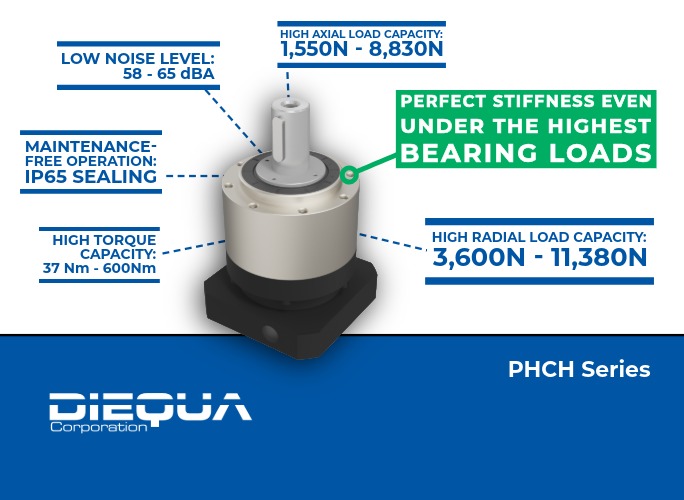
-- Optimized Tooth Engagement: Helical gear meshes provide continuous contact overlap to suppress torque ripple and lower acoustic noise down to 56 dBA.
Upgrading to stiff gearhead designs, such as the PHF Series, enables higher gain tuning, eliminates position overshoot, and maximizes machine throughput.
Design engineers attempting to reduce machine cycle times in high-dynamic servo applications often face a critical bottleneck: lost positioning accuracy due to torsional windup and extended settling times. When high-inertia loads undergo rapid acceleration and abrupt deceleration, dynamic torque spikes create intense mechanical force across the gear train. Standard gearhead designs frequently suffer from internal compliance where three main components act like torsion springs:
Cantilevered Planet Pins: Single-supported planet pins deflect under peak torque, leading to gear tooth misalignment.
Carrier Housing Flex: Split or light-duty planet carriers twist relative to the output interface, introducing rotational lag.
Shaft Torsion: Long output shafts add compliance, causing the load to "ring" or oscillate at the end of a motion profile.
The resulting micro-vibrations force automation engineers to add artificial pause times within PLC logic to allow the system to stabilize, directly reducing machine throughput.
To solve these performance bottlenecks, gearheads must be engineered for maximum torsional stiffness rather than focusing solely on backlash. Key design enhancements that eliminate mechanical compliance include:
Integrated Straddle-Bearing Carriers: Built with a rigid, one-piece steel planet carrier where the output flange interface and internal cage are manufactured as a single structure. Supported on both ends with full needle bearings, gear straddle-deflection is virtually eliminated under maximum load.
Direct Flange Interfaces: Utilizing an ISO 9409-1 robotic output flange instead of a long output shaft transmits torque across a larger pitch circle diameter, minimizing rotational deflection.
Optimized Tooth Contact Overlap: Helical gear meshes provide continuous contact overlap to suppress torque ripple during sudden deceleration while reducing acoustic noise down to 56 dBA.
By eliminating mechanical compliance within the gearhead, system integrators can achieve significant performance gains across high-dynamic motion profiles:
Higher Gain Tuning: Servo loops can be tuned with higher proportional gains without triggering control loop resonance or axis ...
+ Read more
By eliminating mechanical compliance within the gearhead, system integrators can achieve significant performance gains across high-dynamic motion profiles:
Higher Gain Tuning: Servo loops can be tuned with higher proportional gains without triggering control loop resonance or axis hunting.
Crisp Deceleration & Zero Overshoot: The robot arm or indexer stops cleanly at target coordinates without position overshoot, eliminating stored mechanical spring energy.
Maximized Throughput: Settling delays in the PLC program can be reduced or eliminated, yielding higher parts-per-minute (PPM) production rates.
Long-Term Precision: Hardened and ground gearing combined with dual needle bearing supports prevent backlash degradation over millions of high-frequency reversing cycles.
Upgrading to stiffer gearhead designs, such as the PHF Series, provides the structural rigidity required to maximize machine throughput and accuracy in demanding automation applications.
- Read less
Published by DieQua Corporation on Sep 28, 2026

DieQua Corporation
www.diequa.com/
E: [email protected]
T: 630-980-1133
F: 630-980-1232
Address
180 Covington Drive
Bloomingdale, IL
60108
United States
View map

.jpeg)