Florida International University Leverages VABS Software to Optimize Aerospace Structures, including Wings and Antennas
University conducts research to identify optimal configurations to maximize longevity, enhance safety, and expand function
West Lafayette, Indiana (USA) - AnalySwift, LLC, a provider of efficient high-fidelity modeling software for composites, announced today that Florida International University is participating in its Academic Partner Program (APP), and it is using its VABS simulation software for researching aerospace structures such as wings and antennas. The work is part of the broader Fluid-Structure Interaction (FSI) Laboratory within the Department of Mechanical and Materials Engineering, which seeks to improve aerospace structure design and facilitate stress flow based on the principles of Constructal Law.
The APP offers participating universities no-cost licenses of engineering software programs VABS and SwiftComp so students, researchers, and faculty can leverage the tools in their academic research.
The VABS program is a general-purpose cross-sectional analysis tool for predicting structural beam properties and recovering 3D stresses, strains, and strengths of slender composite structures. It is a powerful tool for modeling composite rotorcraft (helicopter, air mobility, unmanned aerial vehicles) and wind turbine rotor blades, as well as other slender composite structures, such as propellers, landing gear, and high-aspect ratio wings.
“We are excited by the work being done by the Florida International University and pleased they have found VABS helpful in as part of their design and analysis workflow as they improve longevity and functional capabilities of aerospace structures,” said Allan Wood, president & CEO of AnalySwift. “As a versatile cross-sectional analysis tool, VABS delivers high-fidelity results early on to help computationally resolve engineering challenges, reduce trial and errors, and arrive at the best solution more quickly.”
“My research project focuses on developing a Constructal Design approach to identify configurations for aerospace structures that maximize longevity, enhance safety, and expand functional capabilities,” said Hadi Ebrahimi Fakhari, a PhD candidate in Mechanical Engineering in Florida International University. “I support this work through a combination of finite element analysis (FEA), theoretical analysis, and experimental validation.”
“I am conducting research in the Fluid-Structure Interaction (FSI) Laboratory within the Department of Mechanical and Materials Engineering at Florida International University,” continued Fakhari. “In this lab, we analyze the forces and boundary conditions generated by airflow and use them as inputs to study structural responses. Our goal is to improve designs by facilitating smooth stress distribution and preventing stress concentrations, with a primary focus is on aerospace structures, particularly wings and antennas.”
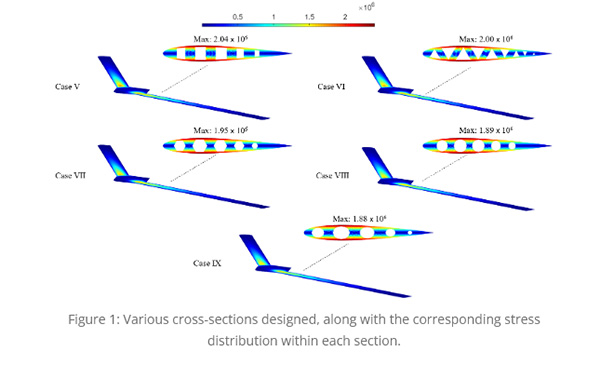
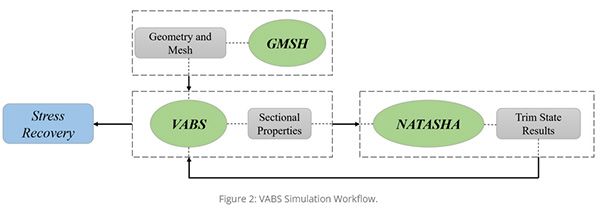
Professor Pezhman Mardanpour, as director of the FSI laboratory described how his team incorporated VABS into their workflow. They first designed the cross-section and used VABS to obtain the stiffness matrix. Then, they utilized another tool to determine the trimmed shape and flutter speed. Finally, they performed stress recovery using VABS once again.
Published by AnalySwift, LLC on Jul 08, 2025